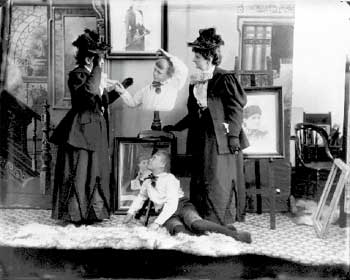
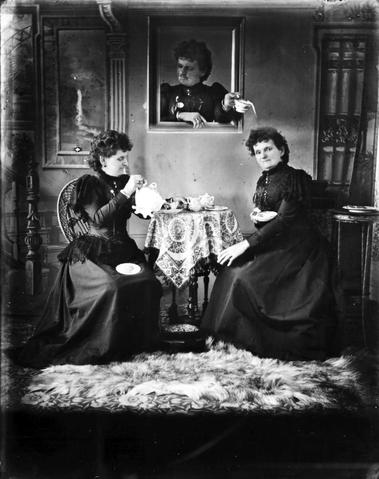
Maurice Merleau-Ponty in Phenomenology of Perception talked about how affective environments can alter or influence a personal phenomenological experience of life-altering events, spaces, landscapes, and people. For example, Hannah Maynard was practicing experimental photography and portraitures in 1878 out of a main street studio in Victoria, B.C. In Hannah Maynard Crafting Professional Identity, Jennifer Salahub identifies Maynard as a woman artist who’s work was celebrated and successful being named the professional photographer of family and children, yet also distilled down to being freakish and eccentric on the other hand (p. 137). Salahub focused on the use of crafts such as, needlepoint, crazy quilts and so on in Maynard’s experimental photograph At The Home to put herself inline with Victorian social landscape in promoting herself as an artist and a professional. Salahub’s analysis of Maynard crafting her identity supports Ponty’s concept of affective environments which did appear to influence her ability to weave conservative visual symbols into an experimental image to make it a bit more palatable for the artistic world of photography, a smidge more liberal than the average Victorian person. I agree with some of the scholars that Salahub mentioned, I do see a precursor to the Dadaist and Surrealist movement with her ability to layer exposures using very early bulky photography equipment to consciously express an autobiographical photographic image with 3 Maynards somewhat affecting each other within the same pallor space (p. 137). On the right hand side, Maynard is looking confidently at the observer as thou she was just interrupted, on the left the second Maynard is pouring tea looking down at the tea pot and the third Maynard is pouring cream on the head of the first Maynard all the while she is looking down on the second Maynard from the picture frame above the tea table. I don’t see a freakish image. I see a Victorian woman, who had to keep 3 different identities inline within a conservative Canadian colonial culture to participate and contribute to a society that constricted and limited women’s professions.
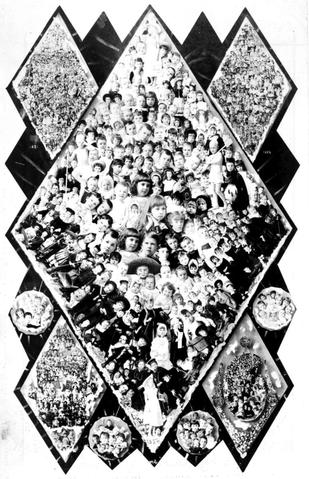
Maynard was crafting a professional identity through the photographic technique experimental practice inspired by the practice of needlework crafts while also including her personal quilts and handcrafts as symbolism to the testament to her motherhood identity (p.138). Down below is a photographic collage of faces of children, titled Gems of British Columbia which all began as a clever marketing tool for her studio. In Victoria, B.C during Maynard’s lifetime the infant mortality rate was high which affected the residence of the city to annually have family portraits done as a form of documentation of children and family members. Every Christmas, Maynard would collage all the faces of the children that year she photographed into a quilt like design image in a post card scale to be given to her client so they would have a memorabilia item they could be displayed on their parlour tables. Over a decade or more of her producing these postcard photographic collages, she received much admiration and recognition through the local papers far and wide “noting that her Gems of British Columbia “are very clever productions, and bear evidence of much ability and perseverance (p 157).”63
I highly recommend you take the opportunity to read the complete essay in the book Rethinking Professionalism: Women and Art in Canada to gain more understanding and orientate yourself as a Woman in Canada.
Jennifer Salahub, “Hannah Maynard Crafting Professional Identity” in Rethinking Professionalism: Women and Art in Canada 1850-1970. Eds. Kristina Huneault, Janice Anderson. McGill-Queen’s University Press, 2012, p. 135-167
 Hope Wells Landscape Studio